4.13. DSS Example: Avoided Harvesting
This notebook is an example implementation of a notebook-based decision-support system (DSS) for evaluating the net system-level carbon emissions impact of an avoided harvesting type project.
4.13.1. DSS implementation notes
At its core this DSS prototype uses ws3 and libcbm_py to do most of the heavy lifting in terms of simulating forest growth, simulating harvesting disturbances, and simulating forest ecosystem carbon stocks and fluxes. ws3 includes built-in functions that automate most of process of compiling CBM input data, importing this input data into CBM, running CBM, and extracting CBM output data in tablular format. We layer onto this some custom functions to simulate multiple decaying pools of harvested wood products (HWP), and displacement effects for these.
This DSS assumes we are using the standard “alternative scenario net of baseline scenario” approach to defining net carbon emissions, so we include functions that automate the process of pushing a pair of (baseline, alternative) scenarios through the simulation pipeline, collecting the output from each scenario, calculating the difference across scenarios (alternative minus baseline) and displaying this contrast as a function of time.
We include a few interactive widgets to show how these can be used to implement a more user-friendly interface for the DSS while keeping the flexibility and low overhead cost of using a Jupyter notebook environment to implement the DSS.
Note that most of the complex code that defines the behaviour of the DSS and underlying simulation engines is implemented in a companion util Python module. The functions we need from the util module are imported at the top of this notebook.
It is also possible to further “hide” the code parts of a Jupyter notebook-based DSS dashboard application by linking all required parameters and controls to interactive widgets (see some examples of widgets below), and then running the notebook throught the Voilà dashboard interface (not tested here, but Voilà is part of the standard ecosystem of Jupyter software should not be a problem). For anyone more familiar with the R programming environment, Voilà is to JupyterLab as Shiny is to RStudio (if this analogy is lost on you, then it was not meant for you).
4.13.2. Description of case
The study area for this case is a small subset of timber supply area (TSA) 17 in British Columbia. There has been little or no harvesting in this area to date, but in this hypothetical case we are supposing that there are plans to begin actively harvesting this area in the near future. We are assuming that harvesting will be planned such that an even flow of merchantable timber volume is extracted from the study area (over an arbitrary 100-year simulation horizon, althought the system can easily be parametrized to simulate shorter or longer horizons). We assume that the harvesting will begin unless someone “buys out” and holds the harvesting rights without exploiting them (effectively implementing a “no harvesting” policy going forward). In this situation, the “harvesting” policy represents the baseline scenario and the “no harvesting” policy is the alternative scenario.
[1]:
%load_ext autoreload
%autoreload
Optionally, uninstall the ws3 package and replace it with a pointer to this local clone of the GitHub repository code (useful if you want ot tweak the source code for whatever reason).
[2]:
clobber_ws3 = True
if clobber_ws3:
    %pip uninstall -y ws3
    %pip install -e ..
Found existing installation: ws3 1.1.0.dev0
Uninstalling ws3-1.1.0.dev0:
  Successfully uninstalled ws3-1.1.0.dev0
Note: you may need to restart the kernel to use updated packages.
Obtaining file:///home/gep/tmp/ws3
  Installing build dependencies ... done
  Checking if build backend supports build_editable ... done
  Getting requirements to build editable ... done
  Installing backend dependencies ... done
  Preparing editable metadata (pyproject.toml) ... done
Requirement already satisfied: dill in /home/gep/tmp/ws3/.venv/lib/python3.12/site-packages (from ws3==1.1.0.dev0) (0.4.0)
Requirement already satisfied: fiona in /home/gep/tmp/ws3/.venv/lib/python3.12/site-packages (from ws3==1.1.0.dev0) (1.10.1)
Requirement already satisfied: gurobipy in /home/gep/tmp/ws3/.venv/lib/python3.12/site-packages (from ws3==1.1.0.dev0) (12.0.3)
Requirement already satisfied: highspy in /home/gep/tmp/ws3/.venv/lib/python3.12/site-packages (from ws3==1.1.0.dev0) (1.11.0)
Requirement already satisfied: libcbm in /home/gep/tmp/ws3/.venv/lib/python3.12/site-packages (from ws3==1.1.0.dev0) (2.8.1)
Requirement already satisfied: matplotlib in /home/gep/tmp/ws3/.venv/lib/python3.12/site-packages (from ws3==1.1.0.dev0) (3.10.5)
Requirement already satisfied: numpy>=1.21 in /home/gep/tmp/ws3/.venv/lib/python3.12/site-packages (from ws3==1.1.0.dev0) (2.2.6)
Requirement already satisfied: pandas>=1.3 in /home/gep/tmp/ws3/.venv/lib/python3.12/site-packages (from ws3==1.1.0.dev0) (2.3.1)
Requirement already satisfied: profilehooks in /home/gep/tmp/ws3/.venv/lib/python3.12/site-packages (from ws3==1.1.0.dev0) (1.13.0)
Requirement already satisfied: pulp in /home/gep/tmp/ws3/.venv/lib/python3.12/site-packages (from ws3==1.1.0.dev0) (3.2.2)
Requirement already satisfied: rasterio in /home/gep/tmp/ws3/.venv/lib/python3.12/site-packages (from ws3==1.1.0.dev0) (1.4.3)
Requirement already satisfied: scipy>=1.7 in /home/gep/tmp/ws3/.venv/lib/python3.12/site-packages (from ws3==1.1.0.dev0) (1.16.1)
Requirement already satisfied: python-dateutil>=2.8.2 in /home/gep/tmp/ws3/.venv/lib/python3.12/site-packages (from pandas>=1.3->ws3==1.1.0.dev0) (2.9.0.post0)
Requirement already satisfied: pytz>=2020.1 in /home/gep/tmp/ws3/.venv/lib/python3.12/site-packages (from pandas>=1.3->ws3==1.1.0.dev0) (2025.2)
Requirement already satisfied: tzdata>=2022.7 in /home/gep/tmp/ws3/.venv/lib/python3.12/site-packages (from pandas>=1.3->ws3==1.1.0.dev0) (2025.2)
Requirement already satisfied: six>=1.5 in /home/gep/tmp/ws3/.venv/lib/python3.12/site-packages (from python-dateutil>=2.8.2->pandas>=1.3->ws3==1.1.0.dev0) (1.17.0)
Requirement already satisfied: attrs>=19.2.0 in /home/gep/tmp/ws3/.venv/lib/python3.12/site-packages (from fiona->ws3==1.1.0.dev0) (25.3.0)
Requirement already satisfied: certifi in /home/gep/tmp/ws3/.venv/lib/python3.12/site-packages (from fiona->ws3==1.1.0.dev0) (2025.8.3)
Requirement already satisfied: click~=8.0 in /home/gep/tmp/ws3/.venv/lib/python3.12/site-packages (from fiona->ws3==1.1.0.dev0) (8.2.1)
Requirement already satisfied: click-plugins>=1.0 in /home/gep/tmp/ws3/.venv/lib/python3.12/site-packages (from fiona->ws3==1.1.0.dev0) (1.1.1.2)
Requirement already satisfied: cligj>=0.5 in /home/gep/tmp/ws3/.venv/lib/python3.12/site-packages (from fiona->ws3==1.1.0.dev0) (0.7.2)
Requirement already satisfied: numexpr>=2.8.7 in /home/gep/tmp/ws3/.venv/lib/python3.12/site-packages (from libcbm->ws3==1.1.0.dev0) (2.11.0)
Requirement already satisfied: numba in /home/gep/tmp/ws3/.venv/lib/python3.12/site-packages (from libcbm->ws3==1.1.0.dev0) (0.61.2)
Requirement already satisfied: pyyaml in /home/gep/tmp/ws3/.venv/lib/python3.12/site-packages (from libcbm->ws3==1.1.0.dev0) (6.0.2)
Requirement already satisfied: mock in /home/gep/tmp/ws3/.venv/lib/python3.12/site-packages (from libcbm->ws3==1.1.0.dev0) (5.2.0)
Requirement already satisfied: openpyxl in /home/gep/tmp/ws3/.venv/lib/python3.12/site-packages (from libcbm->ws3==1.1.0.dev0) (3.1.5)
Requirement already satisfied: contourpy>=1.0.1 in /home/gep/tmp/ws3/.venv/lib/python3.12/site-packages (from matplotlib->ws3==1.1.0.dev0) (1.3.3)
Requirement already satisfied: cycler>=0.10 in /home/gep/tmp/ws3/.venv/lib/python3.12/site-packages (from matplotlib->ws3==1.1.0.dev0) (0.12.1)
Requirement already satisfied: fonttools>=4.22.0 in /home/gep/tmp/ws3/.venv/lib/python3.12/site-packages (from matplotlib->ws3==1.1.0.dev0) (4.59.0)
Requirement already satisfied: kiwisolver>=1.3.1 in /home/gep/tmp/ws3/.venv/lib/python3.12/site-packages (from matplotlib->ws3==1.1.0.dev0) (1.4.8)
Requirement already satisfied: packaging>=20.0 in /home/gep/tmp/ws3/.venv/lib/python3.12/site-packages (from matplotlib->ws3==1.1.0.dev0) (25.0)
Requirement already satisfied: pillow>=8 in /home/gep/tmp/ws3/.venv/lib/python3.12/site-packages (from matplotlib->ws3==1.1.0.dev0) (11.3.0)
Requirement already satisfied: pyparsing>=2.3.1 in /home/gep/tmp/ws3/.venv/lib/python3.12/site-packages (from matplotlib->ws3==1.1.0.dev0) (3.2.3)
Requirement already satisfied: llvmlite<0.45,>=0.44.0dev0 in /home/gep/tmp/ws3/.venv/lib/python3.12/site-packages (from numba->libcbm->ws3==1.1.0.dev0) (0.44.0)
Requirement already satisfied: et-xmlfile in /home/gep/tmp/ws3/.venv/lib/python3.12/site-packages (from openpyxl->libcbm->ws3==1.1.0.dev0) (2.0.0)
Requirement already satisfied: affine in /home/gep/tmp/ws3/.venv/lib/python3.12/site-packages (from rasterio->ws3==1.1.0.dev0) (2.4.0)
Building wheels for collected packages: ws3
  Building editable for ws3 (pyproject.toml) ... done
  Created wheel for ws3: filename=ws3-1.1.0.dev0-py3-none-any.whl size=4136 sha256=5df49d1809d2f15004f3046010971c142390fb47fb3bfa7620b09e11903424a7
  Stored in directory: /tmp/pip-ephem-wheel-cache-xsdhc43v/wheels/fa/4b/10/3fe4b92a02fb87987a6fe53a10fad0a22a781bf98cd7b63f17
Successfully built ws3
Installing collected packages: ws3
Successfully installed ws3-1.1.0.dev0
Note: you may need to restart the kernel to use updated packages.
[3]:
%pip install -r requirements.txt
Requirement already satisfied: seaborn in /home/gep/tmp/ws3/.venv/lib/python3.12/site-packages (from -r requirements.txt (line 1)) (0.13.2)
Requirement already satisfied: geopandas in /home/gep/tmp/ws3/.venv/lib/python3.12/site-packages (from -r requirements.txt (line 2)) (1.1.1)
Requirement already satisfied: ipywidgets in /home/gep/tmp/ws3/.venv/lib/python3.12/site-packages (from -r requirements.txt (line 3)) (8.1.7)
Requirement already satisfied: numpy!=1.24.0,>=1.20 in /home/gep/tmp/ws3/.venv/lib/python3.12/site-packages (from seaborn->-r requirements.txt (line 1)) (2.2.6)
Requirement already satisfied: pandas>=1.2 in /home/gep/tmp/ws3/.venv/lib/python3.12/site-packages (from seaborn->-r requirements.txt (line 1)) (2.3.1)
Requirement already satisfied: matplotlib!=3.6.1,>=3.4 in /home/gep/tmp/ws3/.venv/lib/python3.12/site-packages (from seaborn->-r requirements.txt (line 1)) (3.10.5)
Requirement already satisfied: pyogrio>=0.7.2 in /home/gep/tmp/ws3/.venv/lib/python3.12/site-packages (from geopandas->-r requirements.txt (line 2)) (0.11.1)
Requirement already satisfied: packaging in /home/gep/tmp/ws3/.venv/lib/python3.12/site-packages (from geopandas->-r requirements.txt (line 2)) (25.0)
Requirement already satisfied: pyproj>=3.5.0 in /home/gep/tmp/ws3/.venv/lib/python3.12/site-packages (from geopandas->-r requirements.txt (line 2)) (3.7.1)
Requirement already satisfied: shapely>=2.0.0 in /home/gep/tmp/ws3/.venv/lib/python3.12/site-packages (from geopandas->-r requirements.txt (line 2)) (2.1.1)
Requirement already satisfied: comm>=0.1.3 in /home/gep/tmp/ws3/.venv/lib/python3.12/site-packages (from ipywidgets->-r requirements.txt (line 3)) (0.2.3)
Requirement already satisfied: ipython>=6.1.0 in /home/gep/tmp/ws3/.venv/lib/python3.12/site-packages (from ipywidgets->-r requirements.txt (line 3)) (9.4.0)
Requirement already satisfied: traitlets>=4.3.1 in /home/gep/tmp/ws3/.venv/lib/python3.12/site-packages (from ipywidgets->-r requirements.txt (line 3)) (5.14.3)
Requirement already satisfied: widgetsnbextension~=4.0.14 in /home/gep/tmp/ws3/.venv/lib/python3.12/site-packages (from ipywidgets->-r requirements.txt (line 3)) (4.0.14)
Requirement already satisfied: jupyterlab_widgets~=3.0.15 in /home/gep/tmp/ws3/.venv/lib/python3.12/site-packages (from ipywidgets->-r requirements.txt (line 3)) (3.0.15)
Requirement already satisfied: decorator in /home/gep/tmp/ws3/.venv/lib/python3.12/site-packages (from ipython>=6.1.0->ipywidgets->-r requirements.txt (line 3)) (5.2.1)
Requirement already satisfied: ipython-pygments-lexers in /home/gep/tmp/ws3/.venv/lib/python3.12/site-packages (from ipython>=6.1.0->ipywidgets->-r requirements.txt (line 3)) (1.1.1)
Requirement already satisfied: jedi>=0.16 in /home/gep/tmp/ws3/.venv/lib/python3.12/site-packages (from ipython>=6.1.0->ipywidgets->-r requirements.txt (line 3)) (0.19.2)
Requirement already satisfied: matplotlib-inline in /home/gep/tmp/ws3/.venv/lib/python3.12/site-packages (from ipython>=6.1.0->ipywidgets->-r requirements.txt (line 3)) (0.1.7)
Requirement already satisfied: pexpect>4.3 in /home/gep/tmp/ws3/.venv/lib/python3.12/site-packages (from ipython>=6.1.0->ipywidgets->-r requirements.txt (line 3)) (4.9.0)
Requirement already satisfied: prompt_toolkit<3.1.0,>=3.0.41 in /home/gep/tmp/ws3/.venv/lib/python3.12/site-packages (from ipython>=6.1.0->ipywidgets->-r requirements.txt (line 3)) (3.0.51)
Requirement already satisfied: pygments>=2.4.0 in /home/gep/tmp/ws3/.venv/lib/python3.12/site-packages (from ipython>=6.1.0->ipywidgets->-r requirements.txt (line 3)) (2.19.2)
Requirement already satisfied: stack_data in /home/gep/tmp/ws3/.venv/lib/python3.12/site-packages (from ipython>=6.1.0->ipywidgets->-r requirements.txt (line 3)) (0.6.3)
Requirement already satisfied: wcwidth in /home/gep/tmp/ws3/.venv/lib/python3.12/site-packages (from prompt_toolkit<3.1.0,>=3.0.41->ipython>=6.1.0->ipywidgets->-r requirements.txt (line 3)) (0.2.13)
Requirement already satisfied: parso<0.9.0,>=0.8.4 in /home/gep/tmp/ws3/.venv/lib/python3.12/site-packages (from jedi>=0.16->ipython>=6.1.0->ipywidgets->-r requirements.txt (line 3)) (0.8.4)
Requirement already satisfied: contourpy>=1.0.1 in /home/gep/tmp/ws3/.venv/lib/python3.12/site-packages (from matplotlib!=3.6.1,>=3.4->seaborn->-r requirements.txt (line 1)) (1.3.3)
Requirement already satisfied: cycler>=0.10 in /home/gep/tmp/ws3/.venv/lib/python3.12/site-packages (from matplotlib!=3.6.1,>=3.4->seaborn->-r requirements.txt (line 1)) (0.12.1)
Requirement already satisfied: fonttools>=4.22.0 in /home/gep/tmp/ws3/.venv/lib/python3.12/site-packages (from matplotlib!=3.6.1,>=3.4->seaborn->-r requirements.txt (line 1)) (4.59.0)
Requirement already satisfied: kiwisolver>=1.3.1 in /home/gep/tmp/ws3/.venv/lib/python3.12/site-packages (from matplotlib!=3.6.1,>=3.4->seaborn->-r requirements.txt (line 1)) (1.4.8)
Requirement already satisfied: pillow>=8 in /home/gep/tmp/ws3/.venv/lib/python3.12/site-packages (from matplotlib!=3.6.1,>=3.4->seaborn->-r requirements.txt (line 1)) (11.3.0)
Requirement already satisfied: pyparsing>=2.3.1 in /home/gep/tmp/ws3/.venv/lib/python3.12/site-packages (from matplotlib!=3.6.1,>=3.4->seaborn->-r requirements.txt (line 1)) (3.2.3)
Requirement already satisfied: python-dateutil>=2.7 in /home/gep/tmp/ws3/.venv/lib/python3.12/site-packages (from matplotlib!=3.6.1,>=3.4->seaborn->-r requirements.txt (line 1)) (2.9.0.post0)
Requirement already satisfied: pytz>=2020.1 in /home/gep/tmp/ws3/.venv/lib/python3.12/site-packages (from pandas>=1.2->seaborn->-r requirements.txt (line 1)) (2025.2)
Requirement already satisfied: tzdata>=2022.7 in /home/gep/tmp/ws3/.venv/lib/python3.12/site-packages (from pandas>=1.2->seaborn->-r requirements.txt (line 1)) (2025.2)
Requirement already satisfied: ptyprocess>=0.5 in /home/gep/tmp/ws3/.venv/lib/python3.12/site-packages (from pexpect>4.3->ipython>=6.1.0->ipywidgets->-r requirements.txt (line 3)) (0.7.0)
Requirement already satisfied: certifi in /home/gep/tmp/ws3/.venv/lib/python3.12/site-packages (from pyogrio>=0.7.2->geopandas->-r requirements.txt (line 2)) (2025.8.3)
Requirement already satisfied: six>=1.5 in /home/gep/tmp/ws3/.venv/lib/python3.12/site-packages (from python-dateutil>=2.7->matplotlib!=3.6.1,>=3.4->seaborn->-r requirements.txt (line 1)) (1.17.0)
Requirement already satisfied: executing>=1.2.0 in /home/gep/tmp/ws3/.venv/lib/python3.12/site-packages (from stack_data->ipython>=6.1.0->ipywidgets->-r requirements.txt (line 3)) (2.2.0)
Requirement already satisfied: asttokens>=2.1.0 in /home/gep/tmp/ws3/.venv/lib/python3.12/site-packages (from stack_data->ipython>=6.1.0->ipywidgets->-r requirements.txt (line 3)) (3.0.0)
Requirement already satisfied: pure-eval in /home/gep/tmp/ws3/.venv/lib/python3.12/site-packages (from stack_data->ipython>=6.1.0->ipywidgets->-r requirements.txt (line 3)) (0.2.3)
Note: you may need to restart the kernel to use updated packages.
[4]:
import math
import matplotlib.pyplot as plt
import pandas as pd
import ipywidgets as widgets
from IPython.display import display
import ws3.forest
from util import results_scenarios
[5]:
base_year = 2020
horizon = 10
period_length = 10
max_age = 1000
n_steps = 100
tvy_name = "totvol"
Create some interactive widgets to control four model parameters. The widgets have reasonable default values defined, but DSS users can override these default values. There are many (thousands!) of other model parameters that could modified to tweak model behaviour. These are complex models, and in the end the quality of output data is limited by the quality of input parameter choices (many of which require expert judgement).
[6]:
max_harvest = widgets.FloatSlider(min=0, max=1, step=0.05, description="Max_harvest:", value=1)
clt_percentage = widgets.FloatSlider(min=0, max=1, step=0.1, description="CLT_percent:", value=0.5)
credibility = widgets.FloatSlider(min=0, max=1, step=0.1, description="Credibility:", value=1)
budget_input = widgets.FloatText(
    value=10000000,
    description="Budget:",
    disabled=False)
display(max_harvest, clt_percentage, credibility)
display(budget_input)
[7]:
max_harvest = max_harvest.value
clt_percentage = clt_percentage.value
credibility = credibility.value
budget_input = budget_input.value
[8]:
fm = ws3.forest.ForestModel(model_name="tsa24_clipped",
                            model_path="data/woodstock_model_files_tsa24_clipped",
                            base_year=base_year,
                            horizon=horizon,
                            period_length=period_length,
                            max_age=max_age)
fm.import_landscape_section()
fm.import_areas_section(convert_periods_to_years=period_length)
fm.import_yields_section(convert_periods_to_years=period_length)
fm.import_actions_section(convert_periods_to_years=period_length)
fm.import_transitions_section(convert_periods_to_years=period_length)
fm.initialize_areas()
fm.add_null_action()
fm.reset_actions()
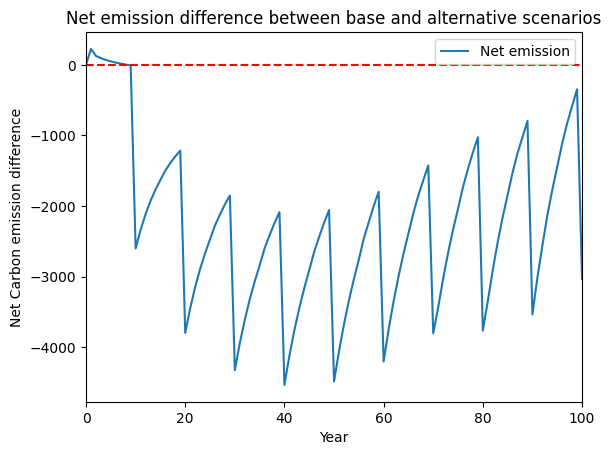
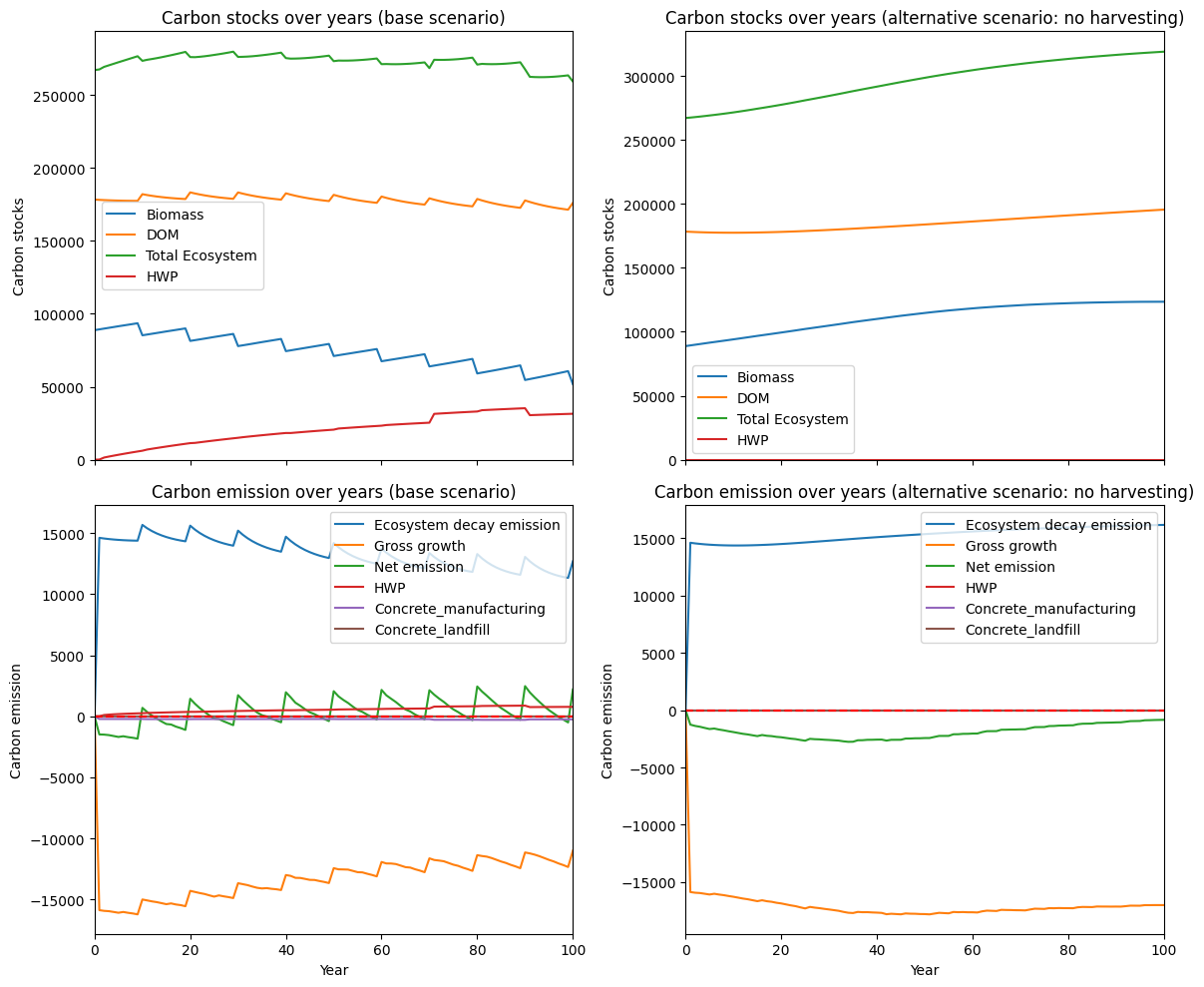
Run the simulations and compile output data into a “dashboard” of graphs. The grid of four subfigures shows carbon stocks and emissions for both baseline and alternative scenarios. The figure on the bottom shows the contrast (difference) between net emissions for alternative and baseline scenarios. The contrast is a negative number (in most time steps), which means that according to this simulation the alternative (no harvesting) scenario generally has lower emissions behaviour than the baseline (high even-flow harvesting) scenario.
However, close inspection of the detailed scenario-wise emissions graphs reveals that the absolute magnitude of the “net emission” indictator for each of the scenarios is relatively small compared to the absolute magnitude of “ecosystem decay” and “gross growth” emissions (which dominate the net emissions calculation, and come close to cancelling each other out completely). Furthermore, side-by-side visual inspection of the relatively small-magnitude “net emissions” profiles for each scenario shows that they are very similar.
So, althrough this model is calculating a net negative impact of the “no harvesting” scenario relative to the “with harvesting” scenario, the magnitude of this impact is small enough (compared to the magnitude of the constituent carbon emission components that are summed to calculate the net emission indicator) to trigger a “materiality” criterion challenge. Materiality is further challenged when one considers the relatively low confidence (i.e., high uncertainty) associated with some of the key input assumptions used in this deterministic analysis).
As a further example of how the flexibility of this type of notebook-based DSS implementation, we automate the process of calculating the avoided emissions for the first 25 years of the simulation horizon (i.e., the area under the leftmost part of the curve in the bottom figure in the dashboard), and dividing this number into a hypothetical “budget” for buying out the harvesting rights, yielding a “unit cost of avoided emissions” (in $ per tCO2e). This is the same sort of calculation (minus a full-blown techno-economic analysis to back up the budget value in the numerator) used by economists to compile marginal abatement cost curve (MACC) figures. For example, the DSS prototype as it is implemented could be re-run multiple times to find (through trial and error) the maximum total price one would want to bid to buy out the harvesting rights on this piece of land, given a maximum “unit cost of avoided emissions” price we were willing to pay (above which price maybe it would be more economically efficient to invest our “carbon money” elsewhere, or just purchase ready-baked carbon offset credits from one of several retail voluntary carbon offset markets).
[9]:
results_scenarios(fm, clt_percentage, credibility, budget_input, n_steps, max_harvest)
Net emission difference -33135.75581653893
Net emission base scenario -14942.929917141291
Net emission alternative scenario -48078.685733680206
dollar_per_ton is:  301.78880045370016